
At the end of the year, I receive economic updates from numerous groups. I’ve tried to synthesize what a number of these major firms are saying about multifamily real estate as we head into 2026.
As we enter 2026, multifamily remains one of the most resilient and investable sectors in U.S. commercial real estate. Across major institutional and brokerage research — including Blackstone, CBRE, Marcus & Millichap, Cushman & Wakefield, and Colliers — several consistent themes emerge: stable fundamentals, constrained new supply, persistent renter demand, and improving capital markets.
Macro Backdrop & Labor Market Impacts
The broader U.S. economy saw job creation slow significantly in 2025, with average monthly gains dropping sharply and unemployment edging higher. While softer employment can weigh on overall space demand, multifamily has held up better than other property types. High for-sale housing costs and limited ownership options are keeping many households in the rental market, providing ongoing support for apartment demand.
CBRE and Cushman & Wakefield both emphasize that demand remains anchored in demographics and affordability — with Millennials and younger cohorts unable or unwilling to transition to ownership at previous rates — even as rent growth moderates.
Supply Constraints & Structural Tailwinds
One of the most powerful drivers of multifamily outlook is the sharp contraction in new supply. Blackstone highlights that construction starts for multifamily and other major sectors are down more than 60% from peak levels, largely due to higher costs for labor and materials, elevated finance costs, and tighter underwriting. This supply retrenchment supports tighter fundamentals over time: fewer completions allow occupancies to remain firm and help sustain rental growth as demand absorbs the existing pipeline.
Cushman & Wakefield research echoes this dynamic, noting that income-producing property sectors like multifamily are seeing rising transactions and investor interest as capital rotates toward stable cash flows in an evolving cycle.
Fundamentals: Occupancy & Rent Trends
Multifamily net absorption continues to be positive, though at a more measured pace than in the post-pandemic rebound. National vacancy rates are projected to remain near historical norms — likely in the mid-4% range — as supply growth slows further in 2026. CBRE forecasts show many major markets tightening even as deliveries continue. Rent growth is expected to be moderate but sustained, providing a reliable income foundation for investors.
Marcus & Millichap also points to strong multifamily fundamentals, noting that secondary and Sun Belt markets with tight housing supply and strong job markets will likely outperform on rent and occupancy metrics.
Capital Markets & Investment Sentiment
Investor sentiment toward multifamily has strengthened, driven by resilient fundamentals and more favorable financing conditions. Blackstone’s recent commentary highlights an inflection in capital markets: debt costs have declined from recent peaks, commercial mortgage issuance has increased, and real estate valuations — though reset lower during the downturn — have begun to stabilize. This creates what Blackstone describes as one of the more compelling entry points in years for disciplined real estate capital.
Colliers’ annual investor outlook likewise shows broadening capital strategies, with many investors favoring active and value-add multifamily plays even as core allocations remain desirable but undersupplied.
Risks & Opportunities
Key risks include ongoing labor market softness, refinancing pressure from floating-rate debt maturities, and localized oversupply in high-delivery markets. However, these risks also create opportunities for value-add and opportunistic investors — particularly those focused on repositioning assets, lease-up plays, or markets with constrained housing alternatives.
Conclusion
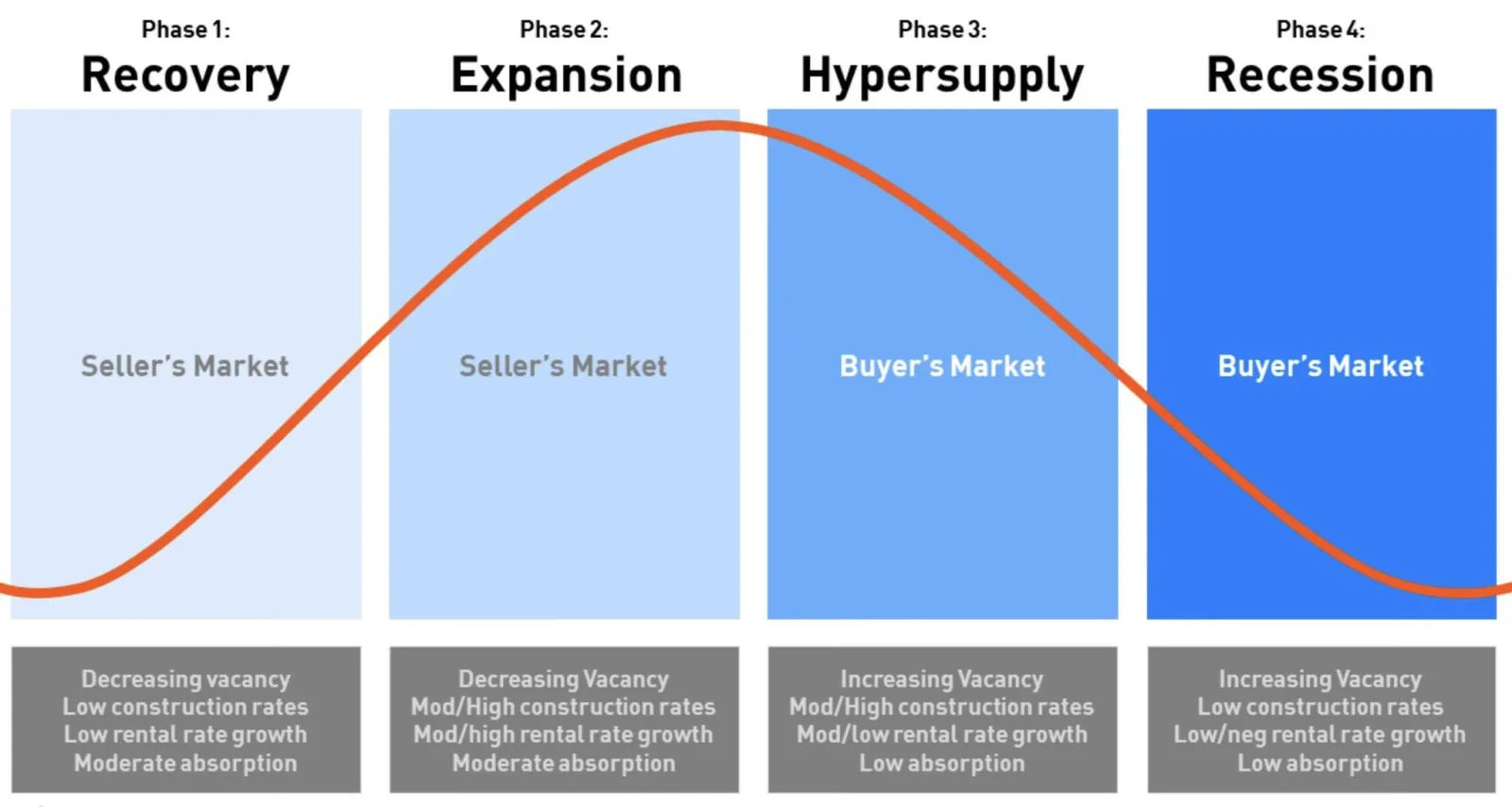
Taken together, insights from Blackstone, CBRE, Marcus & Millichap, Cushman & Wakefield, and Colliers suggest multifamily is near the bottom of the current real estate cycle, with conditions increasingly favorable for new investment.
Valuations have reset lower and are stabilizing, creating attractive entry points. Financing conditions have improved as debt costs retreat from recent peaks and mortgage issuance increases. At the same time, construction starts are down more than 60% from peak levels, setting up a future supply shortage that should support occupancy and rent growth.
Fundamentals remain solid, with vacancy expected to stay near historical norms in the mid-4% range and rent growth moderate but durable.
This environment favors disciplined real estate capital rather than speculation. Investors who underwrite carefully and focus on strong markets may find value-add and opportunistic multifamily strategies particularly compelling as the sector moves into the next phase of the cycle.
